
Louis Cyr's net worth at the time of his death in 1912 was likely in the range of $20,000 to $50,000 in contemporary dollars, which translates roughly to $650,000 to $1,600,000 in 2026 money depending on the conversion method you use. That is a meaningful sum for a working-class French-Canadian athlete of his era, but it is not a fortune by any modern standard. The uncertainty in that range is wide, and it is wide on purpose: the financial records for 19th-century performers are fragmentary at best, and any source claiming a precise modern-equivalent figure without explaining their assumptions should be treated with skepticism.
Louis Cyr Net Worth Estimate: Earnings and Methods

Julien Mercier
20 May 2026
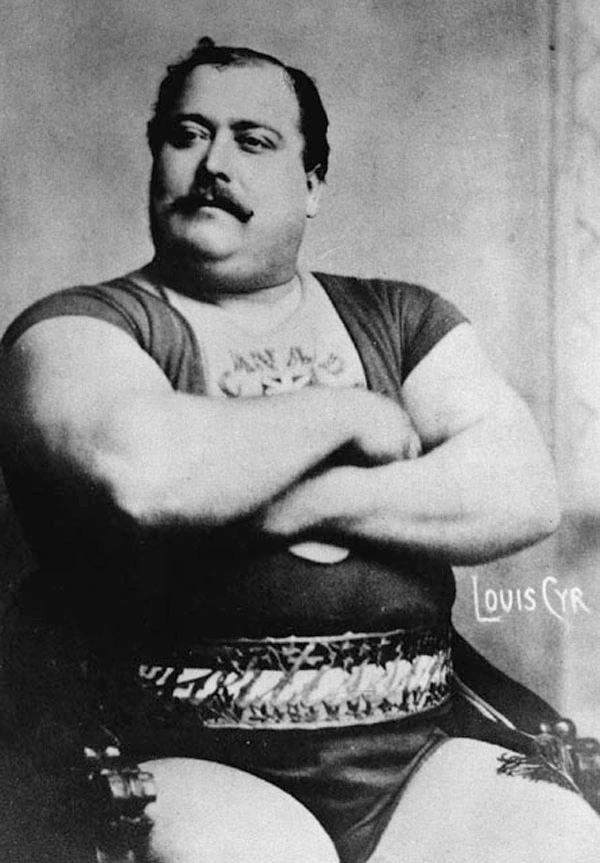
Who Louis Cyr was and why net-worth estimates are tricky

Louis Cyr (born October 10, 1863, in Saint-Cyprien-de-Napierville, Quebec; died 1912) was one of the most celebrated strongmen of the 19th century, widely described during his lifetime as the strongest man in the world. His career spanned professional competitions, touring exhibitions, and circus engagements across North America and Europe. Parks Canada recognizes him as a National Historic Person, which tells you something about his cultural footprint, but it tells you nothing about his bank account.
Net-worth estimates for historical figures like Cyr are inherently difficult for a few compounding reasons. There are no tax returns to reference, no SEC filings, no probate records that have been widely digitized and published, and no contemporaneous financial journalism covering his personal finances. What we have instead are circus posters, newspaper accounts, a few biographical records from sources like the Dictionary of Canadian Biography, and the Québec cultural heritage register. From those, we can build a reasonable estimate, but we cannot build a precise one. Anyone who gives you a single clean number without this caveat is either guessing or repeating someone else's guess.
What 'net worth' actually means for a historical strongman
Net worth, in its simplest form, is assets minus liabilities. For a modern celebrity, you would add up real estate, investment portfolios, business equity, and cash, then subtract debts. For Louis Cyr, the concept still applies but the inputs are almost entirely inferred. His assets likely included his family home in Quebec, personal property, and whatever savings he had accumulated from touring. His liabilities would have included any debts from the periods when touring income dried up, particularly during his later years when his health declined significantly from Bright's disease (a kidney condition that ended his career and ultimately his life).
It is also worth being clear that Cyr was a performer and athlete, not a business mogul. His wealth was generated almost entirely from his physical labor and public reputation. He did not own a circus, he did not have a licensing empire, and there is no documented evidence of significant investment income. His net worth is essentially the accumulated surplus of his career earnings after living expenses and career costs.
How Cyr made his money

The most concrete earnings anchor we have for Cyr comes from a blank" rel="noopener noreferrer">Library of Congress-archived poster for the John Robinson Circus, which explicitly states he was 'Engaged at a salary of $2,000 per week.' That poster dates to approximately 1898, and the Maison Louis-Cyr museum corroborates this figure. Two thousand dollars a week in 1898 was an extraordinary salary. For context, the average American industrial worker in that period earned roughly $400 to $500 per year. Cyr was earning that in a few days.
His documented and inferable income sources across his career include several categories. From roughly 1886 onward, after he was recognized as 'the strongest man in Canada' following his 2,371-pound back lift against David Michaud in Quebec, Cyr commanded serious appearance fees. From 1892 to 1896, according to the Québec heritage register, he conducted an extensive American touring circuit with his family through the Cyr Brothers Specialty Company, which would have generated both performance fees and some share of gate revenue. His London engagements in the early 1890s, where he competed against European strongmen, likely also paid well given his international profile at the time.
- Circus engagements: documented at $2,000/week for John Robinson Circus circa 1898; other circus deals likely in a similar range during peak years
- Touring exhibitions with the Cyr Brothers Specialty Company (1892–1896): recurring revenue across multiple North American venues
- International competition appearances, including London engagements in the early 1890s
- Challenge match fees: Cyr regularly accepted and issued public strength challenges, which carried prize money and gate-share arrangements
- Post-retirement: limited lecture or exhibition appearances before his health declined
Estimating total career earnings is speculative, but a conservative working estimate: if Cyr averaged even $500 per week across a 20-year active career (a significant downward adjustment from peak rates to account for off-seasons, lean years, and non-circus periods), that implies roughly $500,000 in gross career earnings in historical dollars. Peak circus periods at $2,000/week were exceptional, not the norm, and circus seasons typically ran 20 to 30 weeks per year.
Expenses, management cuts, and what actually stayed in his pocket
Gross earnings and net worth are very different things. Cyr's take-home income would have been reduced by several cost layers that are standard for performers of his era. Circus contracts typically involved travel and accommodation costs that were sometimes covered by the promoter and sometimes borne by the performer. If Cyr was headlining at John Robinson's rates, it is reasonable to assume the circus covered travel, but that cannot be confirmed for all engagements.
Management and promotional arrangements were common in the strongman circuit. Cyr worked with various promoters over his career, and standard management cuts of the era ranged from 10% to 25% of gross earnings. During his Cyr Brothers Specialty Company years, he was in some sense self-promoting, which would have reduced management overhead but increased organizational costs (booking agents, venue deposits, travel logistics for a family touring company).
- Management/promoter fees: estimated 15–25% of gross earnings across career
- Travel and logistics for touring: significant recurring cost, especially during the Cyr Brothers Specialty Company years
- Family living expenses: Cyr supported his family throughout his career; the Québec heritage record ties his family to the touring company
- Medical and health costs: Bright's disease required extended medical care in his final years, which would have depleted savings
- No income tax in Canada or the U.S. for most of his career (U.S. federal income tax was not enacted until 1913, one year after his death)
The absence of income tax is actually meaningful here. Unlike modern athletes who might lose 40% or more to combined federal and state taxes, Cyr kept a much larger share of his gross. That partially offsets the management and expense deductions. A reasonable estimate is that Cyr retained roughly 60% to 70% of his gross performance earnings as spendable income, with the remainder going to expenses and management.
Converting 1890s dollars to 2026 money

This is where the widest variation in estimates originates. There is no single 'correct' way to convert 19th-century dollars to modern equivalents, and different conversion methodologies produce dramatically different results. The three most commonly used approaches are the Consumer Price Index (CPI) adjustment, the wage or income value adjustment, and the economic power or GDP-per-capita adjustment.
| Conversion Method | 1898 $1 equals in 2026 | Notes |
|---|---|---|
| CPI (inflation-based) | ~$37–$40 | Most conservative; tracks purchasing power of goods |
| Wage/income value | ~$80–$100 | Reflects what $1 earned then means relative to today's wages |
| Economic power (GDP per capita) | ~$150–$200 | Reflects broader economic weight; highest multiplier |
Applied to a conservative historical net-worth estimate of $25,000 at death (in 1912 dollars), the CPI method produces roughly $800,000 in 2026 dollars, the wage method produces roughly $1.5 to $2 million, and the economic power method could push it past $3 million. Most general-purpose net-worth databases use CPI adjustment because it is the most straightforward, which is why many published estimates for historical figures appear lower than academic economic history sources would suggest. The methodological choice matters enormously, and responsible estimates should state which method they used.
Why published estimates vary so much
If you search for Louis Cyr's net worth across different websites, you will find figures ranging from a few hundred thousand dollars to several million in modern equivalents. Cyril Camus net worth estimates also vary widely depending on which income and asset sources are included. Some sites claim different figures for the cyril chauquet net worth, but they often do not show how they reached those numbers Louis Cyr's net worth.
Almost none of these sources explain their methodology. The variation comes from three main sources: different conversion methods (as described above), different assumptions about career earnings (some sources use the $2,000/week circus figure as a baseline rather than as a peak), and simple propagation of earlier estimates without independent verification.
Some sources also conflate Cyr's fame and cultural significance with financial wealth, which is a common error in historical net-worth research. Being the most celebrated strongman in the world in 1892 does not necessarily mean you were wealthy by the standards of industrialists or business owners of the same era. Cyr was very well paid for a performing athlete of his time, but he was not in the same financial category as a contemporary railroad baron or factory owner.
For comparison, other historical performers and athletes of Cyr's era who have been more thoroughly documented financially ended their careers with estates that, in modern CPI-adjusted terms, fall in the range of $500,000 to $2 million. That range aligns reasonably with our estimate for Cyr. Be cautious of any source that places his net worth above $5 million in modern dollars without a detailed earnings breakdown, as that would require documented career earnings well above what the archival record supports.
The bottom line: a stated range with honest confidence levels
Putting it all together, here is the most defensible estimate range for Louis Cyr's net worth at the time of his death in 1912, with explicit confidence levels attached. If you are specifically looking for Cyrille Vigneron net worth, the same idea applies: you need documented income and a clear conversion or valuation method to separate reporting from guessing.
| Scenario | Historical Net Worth (1912 $) | 2026 Equivalent (CPI) | 2026 Equivalent (Wage) | Confidence |
|---|---|---|---|---|
| Conservative | $15,000–$20,000 | $450,000–$600,000 | $900,000–$1.2M | Moderate-high |
| Central estimate | $25,000–$35,000 | $750,000–$1.05M | $1.5M–$2.1M | Moderate |
| Optimistic | $40,000–$60,000 | $1.2M–$1.8M | $2.4M–$3.6M | Low-moderate |
The central estimate of $25,000 to $35,000 in 1912 dollars is the most defensible given the documented earnings anchors (the $2,000/week John Robinson Circus salary, the multi-year touring period from 1892 to 1896), plausible expense deductions, and the trajectory of his health decline in his final years. It reflects a career that generated significant income by the standards of his era but also one that came with substantial costs and ended with a prolonged illness that almost certainly reduced whatever accumulated savings he had.
How to verify and where to look for primary sources
If you need to go deeper than this estimate, these are the most productive primary and secondary sources to consult. The Dictionary of Canadian Biography entry on Louis Cyr is the most rigorously sourced biographical record in English and includes archival citations that can point you toward original documentation. The Library of Congress poster archive (the John Robinson Circus broadside, catalog item LCCN2002735831) gives you the single most concrete earnings data point available. Parks Canada's Louis Cyr National Historic Person page provides a useful chronological framework for his career timeline.
- Dictionary of Canadian Biography (dcb.utoronto.ca): search 'Cyr, Louis' for the most thoroughly cited biographical entry
- Library of Congress Prints and Photographs catalog: search for John Robinson Circus posters (LCCN2002735831) to view the $2,000/week salary documentation directly
- Répertoire du patrimoine culturel du Québec: contains career milestone dates that help you map income periods
- Maison Louis-Cyr museum (Saint-Jean-de-Matha, Quebec): the dedicated museum holds physical artifacts and may have access to archival material not available digitally
- Bibliothèque et Archives nationales du Québec (BAnQ): Quebec provincial archives are the best bet for any surviving estate or property records
- MeasuringWorth.com: the most academically rigorous tool for historical dollar conversions, with multiple methods clearly labeled
When evaluating any net-worth claim for a historical figure, ask three questions: What is the documented earnings source? What conversion method was used? And what expenses were deducted? If a source cannot answer all three, the number is more of a guess than an estimate. The research on Cyr is genuinely limited, and that limitation should be acknowledged in any responsible financial profile, including this one.
For context within the broader category of notable French and French-Canadian figures with publicly estimated net worths, Cyr's financial profile is unusual in that it is both historical and entirely performance-based, which makes it more comparable to 19th-century entertainment figures than to contemporary business or media personalities. If you are specifically looking for cyril chapuy net worth figures, treat online numbers as estimates unless they clearly show their conversion method and evidence for earnings publicly estimated net worths. Researchers who also look into figures like Cyrille Vigneron or other modern executives in the French-speaking world will find that the methodology for those estimates relies on entirely different data types (corporate compensation disclosures, equity stakes, real estate records) and carries a very different confidence level than what is possible for a Victorian-era strongman. If you are specifically looking for Cyrille Vigneron net worth, those estimates typically rely on modern public or corporate data that is very different from the archival scraps used for a 19th-century performer.
FAQ
Why do Louis Cyr net worth numbers differ so much between websites?
Most differences come from three unverified inputs, (1) which dollar-to-modern conversion method they use, (2) whether they treat the $2,000/week figure as typical or as a rare peak, and (3) whether they subtract realistic expenses and management cuts. If a site does not state those assumptions, the number is usually not independently calculated.
What is the most defensible way to estimate Louis Cyr net worth from the evidence we have?
Use a two-step approach: start with a conservative career earnings range anchored by the documented John Robinson salary, then apply plausible deductions for expenses, promoter or promoter-covered travel assumptions (when headlining), and management cuts. Finally, convert from 1912 dollars using a clearly stated method (CPI, wage, or economic power).
Did Cyr make most of his money from the circus, or from competitions and touring?
His income likely came from multiple streams, appearance fees for competitions and exhibitions, touring circuits during his peak years, and circus bookings when a headlining role was available. The key caution is that circus posters often highlight best-known gigs, which can cause people to over-weight the rare high-salary periods.
How do you handle taxes when estimating Louis Cyr net worth?
Because income tax systems were different and not comparable to modern withholding, you should not apply modern effective tax rates. A practical estimate is to treat his retained income as largely reduced by costs and management cuts, not by 21st-century tax schedules, and clearly label that assumption.
What expenses should be included in an 1890s performer net worth estimate?
Common categories include travel, lodging, equipment or training-related costs, family touring logistics (since he toured with family during key years), and any venue or deposit costs that might be paid by the performer depending on contract structure. Even when promoters covered some items, you should include a cost cushion for the parts that were not covered.
Could Louis Cyr have built wealth through investments instead of earnings?
There is no strong documentation showing major investment or business ownership income. For a conservative model, treat net worth as mostly accumulated savings from performance surplus after living and career costs, rather than assuming returns on capital.
Is it reasonable to equate Louis Cyr fame with high net worth?
Not always. Being the most celebrated strongman does not automatically imply millionaire-level wealth by industrialist standards. Online estimates can mistake fame-driven demand for evidence of asset accumulation like large estates, ownership stakes, or ongoing revenue streams.
If I see a claim that Louis Cyr net worth was over $5 million in modern dollars, what should I check?
Look for a detailed earnings breakdown that explains (1) how many weeks per year he earned at the top rate versus the average rate, (2) which modern conversion method was used, and (3) what expense and management deductions were applied. Without that, the figure is usually extrapolation from optimistic assumptions.
What does the $20,000 to $50,000 range in 1912 dollars actually represent?
It represents plausible net worth outcomes given fragmentary financial records, where the uncertainty reflects missing details on expenses, debt, contract structures, and how much of his peak earnings were converted into retained assets before health declined.
How can I tell whether a Louis Cyr net worth estimate is methodologically credible?
A credible estimate usually answers three questions: what specific earnings evidence it uses (for example, the John Robinson salary), what conversion method it applies to translate 1912 dollars, and what deductions it assumes for costs and management. If any one of these is absent, treat the number as a guess.
Where is the biggest uncertainty in estimating Louis Cyr net worth?
The largest swing factor is not the currency conversion alone, it is the assumption about average earnings across his whole active career. People often overestimate by using peak-rate logic, instead of lowering typical weekly income for off-seasons, lean years, and periods without major bookings.
Does Cyr’s death in 1912 change how to interpret net worth estimates?
Yes. A net worth estimate at death depends on what portion of lifetime earnings was still saved or held as assets by the end, and his health decline likely reduced both earning ability and spending patterns. That means two models with similar lifetime gross earnings can yield different net worths if one assumes higher final-year depletion or medical-related costs.
Next Article
Cyrille Vigneron Net Worth: Estimate, Method, and Evidence
Estimate Cyrille Vigneron net worth with transparent methodology, evidence, confidence limits, and tips to verify public