
There is no credible, publicly verified net worth figure for Henri Namphy. Based on everything available in the public record as of May 27, 2026, the most honest estimate is that his personal wealth was modest by international standards, likely in the low-to-mid six figures at most, and possibly less. He was a career military officer and brief transitional head of state in one of the world's poorest countries, not a businessman or entrepreneur with documented assets. No audited disclosures, no credible biography with financial detail, and no investigative reporting has put a specific dollar figure on his estate.
Henri Namphy Net Worth 2026: Estimate and How It’s Calculated

Julien Mercier
27 May 2026
Who Henri Namphy was and why people search his wealth

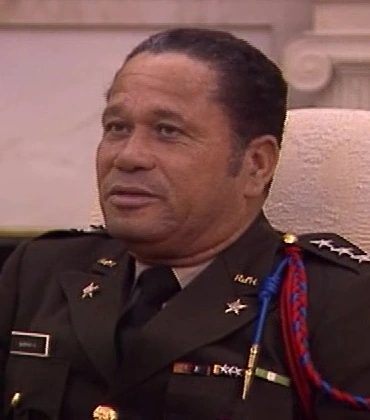
Henri Namphy (October 2, 1932 – June 26, 2018) was a Haitian general who rose to the top of Haiti's military hierarchy and briefly held political power during one of the country's most turbulent periods. When Jean-Claude Duvalier fled Haiti on February 7, 1986, Namphy stepped into the leadership vacuum as president of the National Council of Government, the interim governing body that took over the country.
He held that role until February 7, 1988, then seized the presidency outright through a coup on June 20, 1988, before being deposed himself on September 17, 1988. His military titles during that window included Chief of the General Staff of the Army (from March 1984 to November 1987) and [Commander-in-chief of the Armed Forces of Haiti](https://www. reaganlibrary. gov/public/digitallibrary/smof/publicliaison/breaux/Box-003F/40-064-73579404-003F-001-2018.
pdf) (November 1987 to June 1988).
So why does his name show up in net worth searches? A few reasons feed this curiosity. First, he governed immediately after the Duvalier era, and the Duvalier family was widely reported to have looted hundreds of millions from Haiti's treasury. That association naturally prompts questions about whether Namphy, too, enriched himself in office.
Second, a Washington Post profile from February 1986 described him as having a "taste for luxury," a phrase that circulated in contemporaneous coverage and lodged in the public memory. Third, he was a senior military figure with real institutional power, and people tend to assume that kind of power comes with personal financial gain. Those assumptions don't automatically translate into documented wealth, but they explain the search volume.
If you are specifically comparing figures for Henri Konan Bedie net worth, the same evidence limits and speculation risks apply.
What net worth actually means in this context
Net worth is simply total assets minus total liabilities. LegalClarity defines net worth as total assets minus total liabilities, a standard accounting approach used as the basis for many wealth estimates net worth is simply total assets minus total liabilities. If someone owns a house worth $300,000 and has $50,000 in savings but $100,000 in debt, their net worth is $250,000. That's the standard accounting definition, and it's the framework used by wealth-tracking sites and financial references alike. The challenge is that this calculation requires knowing what someone actually owns and owes, and for private individuals, that information almost never exists in the public domain.
Wealth-estimate sites like CelebrityNetWorth and NetWorth.info publish figures for public figures, but they are explicit (or should be) that these are estimates drawn from public sources, not audited disclosures. For people like major film stars or Fortune 500 executives, there's enough public data (salaries, known property, company equity stakes, public filings) to build a reasonable model. For a military general from a small, impoverished country who died in 2018 without leaving behind documented assets or published financial disclosures, the exercise becomes largely speculative. The estimates on such sites can also vary significantly depending on what asset categories they include or exclude, and how conservatively they handle uncertainty.
The best available estimate of Henri Namphy's net worth

As of May 27, 2026, no major wealth-tracking publication has published a specific, sourced net worth figure for Henri Namphy that can be independently verified. The figures that occasionally appear in search results tend to be recycled from low-quality aggregator sites with no disclosed methodology. Given what is publicly known, a realistic range would be somewhere between $100,000 and $500,000 at his peak, and that range is itself speculative. It reflects the typical financial profile of a senior military officer in a developing country, adjusted upward slightly for the access to resources that comes with heading a government, but not assuming large-scale documented graft without evidence.
Haiti was, and remains, the poorest country in the Western Hemisphere. Military salaries there were not substantial by global standards. Even with the privileges of the presidency, there is no public record of Namphy holding significant foreign bank accounts, real estate portfolios, or business investments. That absence of evidence isn't proof of modesty, but it is a reason to treat inflated figures skeptically. The honest answer is that his net worth is unknown with any precision, and estimates in the high millions are not supported by available evidence.
How this estimate is built: sources and methodology
Because no primary financial disclosure exists for Namphy, any estimate has to be built from indirect public evidence. The methodology here uses a layered approach: start with what is verifiably known (career roles, salary context, country economic conditions), layer in any contemporaneous journalistic reporting that touched on his lifestyle or assets, then apply reasonable benchmarks from comparable figures in similar positions. What gets excluded is speculation from low-quality aggregator sites that provide no sourcing.
- Verified public records: Congressional records, Reagan Presidential Library documents, and Wikipedia-cited sources confirm his roles and timeline but contain no financial data.
- Contemporaneous journalism: Washington Post and El País profiles from 1986 and 1988 provide context about his leadership style and public image, including the "taste for luxury" characterization, but no balance-sheet figures.
- Obituary corroboration: A June 2018 obituary confirmed his death at age 85 and his identity, which matters for ruling out name-mix confusion in search results.
- Country and career context: Haiti's economic conditions and military pay scales in the 1980s inform the baseline salary assumptions.
- Absence of investigative reporting: No major investigative outlet (Washington Post, New York Times, Miami Herald) has published documented figures on personal enrichment by Namphy specifically, unlike the extensive reporting on Duvalier-era looting.
The methodology is honest about what it cannot confirm: whether Namphy moved money offshore, whether he received payments outside his official salary, or whether he had undisclosed property. Those are open questions, not answered ones.
Career roles and financial drivers that shape the estimate
Namphy's financial profile is almost entirely tied to his military and government career. He had no known business interests, no publicly documented investments, and no reported income outside of his official roles. His main career milestones, which are also the main financial drivers in any wealth model, break down like this:
| Career Role | Period | Financial Relevance |
|---|---|---|
| Military officer (rising through ranks) | Pre-1984 | Standard military salary, modest by international standards |
| Chief of the General Staff of the Army | March 1984 – November 1987 | Senior military pay, institutional access, no documented supplemental income |
| President, National Council of Government | February 1986 – February 1988 | Head-of-state stipend and privileges, contemporaneous press noted personal lifestyle |
| Commander-in-chief of Armed Forces | November 1987 – June 1988 | Dual role with presidency; access to state resources |
| President (post-coup) | June 20 – September 17, 1988 | Brief second presidency ended by deposition; no documented asset accumulation reported |
| Post-deposition (exile/retirement) | 1988 – 2018 | No documented income sources; died June 2018 in Dominican Republic |
The post-deposition period is particularly relevant for net worth calculations. Namphy spent his final decades out of power, reportedly in the Dominican Republic. There is no public record of business ventures, consulting income, or significant asset sales during that time. His death in 2018 at age 85 came without the kind of estate reporting or probate publicity that might surface financial details.
Why any net worth figure for Namphy will shift over time
Even a well-researched estimate is a snapshot, not a permanent fact. Figures change for several reasons. New investigative reporting or archival research could surface documents showing offshore accounts or property holdings that are currently unknown. Estate proceedings in Haiti, the Dominican Republic, or elsewhere might eventually enter the public record. A biographer or historian with access to family or government sources could produce detailed financial information that doesn't exist publicly today.
There's also the issue of currency and valuation. If Namphy held assets in Haitian gourdes, their real value in USD terms has fluctuated significantly given Haiti's economic history. Any real estate holdings would need to be valued at current market prices, not purchase prices from decades ago. And if a future investigation were to document government-linked enrichment, that could dramatically revise any current estimate upward. The reverse is also possible: more thorough research could confirm that his personal wealth was genuinely limited, narrowing the range downward. The point is that estimates for private individuals are always provisional.
This dynamic is worth keeping in mind when comparing figures across different wealth-tracking sites. Two sites might show different numbers not because one is wrong and one is right, but because they used different assumptions, different asset categories, or data from different points in time. For figures like Henri Namphy, where primary sources are thin, those differences can be especially large.
How to verify or cross-check wealth estimates yourself

If you want to go beyond what any single site tells you and build a more grounded picture, here's a practical approach:
- Check whether the source discloses its methodology. A credible site will tell you what data it used, what it assumed, and what it cannot confirm. If a site shows a precise figure with no explanation, treat it with skepticism.
- Look for corroboration in journalism. Search newspaper archives (Washington Post, Miami Herald, Le Nouvelliste for Haiti-specific coverage) for any reporting that directly discusses personal assets or financial conduct. If major investigative outlets haven't reported it, be cautious about unsourced claims.
- Cross-reference career data. Verify the person's roles, tenure, and salary context using primary sources like government records, congressional documents, or academic biographies. For Namphy, Wikipedia's sourced timeline is a reasonable starting point, but trace citations back to primary documents where possible.
- Check for estate or probate records. When a public figure dies, estate proceedings sometimes enter the public record. This is more reliable in jurisdictions with strong disclosure rules (U.S., UK, France) than in Haiti or the Dominican Republic, but it's worth checking.
- Look for updated reporting. Wealth estimates can be revised as new information emerges. Run a date-filtered search (past 12 months) to see if any investigative outlet has recently reported on the subject.
- Compare figures across multiple sites with caution. If three sites all show the same number, that often means they copied each other, not that the figure is independently verified. Look for sites that show different numbers and explain why, as that divergence can itself be informative.
- Be especially skeptical of round numbers. A figure like "$5 million" or "$10 million" with no sourcing is almost always a guess dressed up as a fact.
For context, this same verification approach applies to other prominent figures in Haiti's political and economic history. Researchers looking at the finances of Haitian political figures from the same era, or at comparable African political leaders of that period, often run into similar documentation gaps. The challenge isn't unique to Namphy, it's structural to researching wealth in countries where financial transparency was limited and institutional records are incomplete.
The bottom line on what we actually know
Henri Namphy was a powerful figure in a very poor country for a short and turbulent period. The public record shows a military career, a brief presidency, a coup, a deposition, and a long retirement that ended with his death in 2018. It does not show documented wealth.
The best estimate available today places his peak net worth in the low-to-mid six figures, almost entirely derived from his military and government career, with significant uncertainty on both ends of that range. Anyone publishing a precise, large net worth figure for Namphy without citing primary sources is speculating, not reporting. That's not a reason to distrust all net worth research, it's a reason to ask better questions about where the numbers come from.
FAQ
Why do some websites list a very high net worth for Henri Namphy when the article says it is unverified?
Those numbers are usually unsourced, recycled across sites, or built on broad assumptions about political corruption. Without primary documentation (asset titles, bank records, court or probate filings, or audited disclosures), a “precise” high figure is not measurable, it is a guess. If the site does not explain its sources and calculations, treat the figure as speculative.
Is there any way to estimate Henri Namphy’s net worth more accurately if primary financial records are missing?
You can only improve precision by triangulating specific asset evidence, not by adjusting generic ranges. Look for contemporaneous property records, credible reports of specific purchases, litigation, or estate/probate references. Even a few verified facts about real estate or liabilities would tighten the range more than adding more “lifestyle” commentary.
Could Namphy’s “taste for luxury” indicate he had hidden wealth, or does it just mean personal spending?
It could reflect either, but it does not prove it. Luxury spending during or immediately after office can come from official income, short-term access to resources, or social funding, and it can also be funded by someone else. The key difference for net worth is whether there are durable assets (property, investments) versus one-time expenditures.
What period should be used to estimate Henri Namphy’s net worth, the presidency years or later retirement?
For net worth, you ideally choose the point when he held the most assets, which often is not the same as when his public power was highest. The article notes his post-deposition years were reportedly spent out of power, with no public record of business income, so any “peak” estimate should be treated as uncertain and anchored to whatever evidence exists about assets acquired during office versus later.
How should currency conversion be handled if assets were held in Haitian gourdes?
Conversion assumptions can swing results dramatically. A reasonable approach is to value any documented holdings at current market-equivalent rates (not the historical purchase price) and to separate what is known (amount and asset type) from what is unknown. When assets are not documented, currency conversion becomes pure modeling, which increases error.
Do military officers in Haiti typically earn enough for a low-to-mid six-figure profile, or does that seem unusually low or high?
It is plausible for personal wealth to be modest given the article’s context, but “plausible” is not evidence. Salaries and official benefits may not translate into large net worth because of costs, limited savings opportunities, and political volatility. Also, individuals can accumulate wealth in ways that do not look like a normal salary (for example, access to contracts), so assumptions should be conservative without proof.
If Namphy had offshore assets, would that show up in public records later?
Sometimes, but not reliably. Offshore holdings can remain invisible unless there are enforcement actions, disclosures, legal disputes, or searchable corporate or property registries linked to the person. Without those connecting records, offshore wealth cannot be confirmed, so high net worth claims should be rejected unless they identify verifiable mechanisms or documentation.
How reliable are net worth estimates that “rely on contemporaneous journalism” about lifestyle?
Lifestyle reporting can help explain spending or status, but it rarely provides the asset-versus-debt breakdown required for net worth. A useful check is whether journalism mentions specific properties, named investments, bankable transactions, or repeated ownership claims. If it only describes appearance or spending, it should not be used to justify large balance-sheet numbers.
What are the most common mistakes people make when comparing Henri Namphy net worth figures across different sites?
They often compare numbers without checking sources, they ignore whether the site is using different years, they fail to account for currency and valuation assumptions, and they overlook that some sites include pensions, benefits, and contingent assets while others exclude them. Another common mistake is treating a range as a certainty when the underlying data is absent.
If I see a specific dollar amount with no explanation, how can I quickly judge if it is credible?
Use a simple credibility test: ask what primary records support the figure, whether the methodology is described, and whether the website distinguishes estimates from verified data. If the answer is “we inferred it” or “we recycled it,” you should interpret it as low reliability, especially for private individuals where public documentation is minimal.
Next Article
Laurent Fignon Net Worth Estimate: Income, Assets, Sources
Estimate of Laurent Fignon net worth with income sources, assets context, methods, and a reliability checklist.