
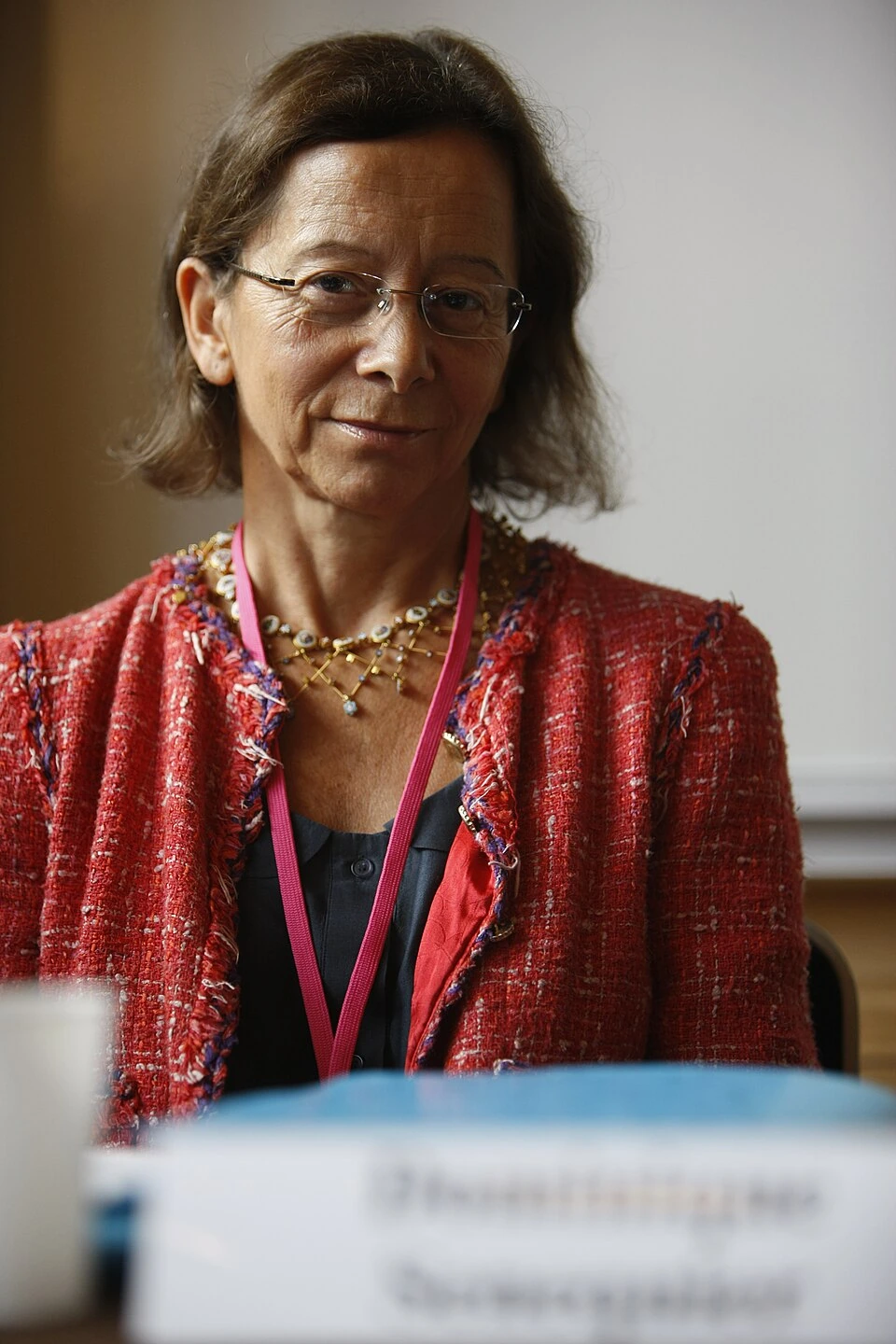
Dominique Senequier is a French businesswoman born on 21 August 1953, best known as the founder and CEO of Ardian, one of Europe's largest independent private equity firms. Her estimated net worth is most credibly placed in a range of roughly $200 million to $600 million USD, depending heavily on assumptions about her personal equity stake in Ardian and the firm's implied valuation. No public filing or audited disclosure confirms a precise figure, and estimates from secondary sites vary significantly because private asset ownership in a firm like Ardian is not publicly reported.
Dominique Senequier Net Worth: How Much Is Known and Estimated

Julien Mercier
25 Apr 2026
Making sure we're talking about the right person

There is some name ambiguity worth clearing up before going any further. The French surname 'Sénéquier' appears in multiple public profiles, including a company listed on Société.com under a similarly spelled name associated with a business in La Valette-du-Var. That entity has nothing to do with the person you're researching. The Dominique Senequier who appears on Forbes, Wikipedia, Ardian's governance page, and French corporate registries like Pappers is unambiguously identified by her birth year (1953), her founding role at AXA Private Equity in 1996, and the subsequent rebranding of that firm to Ardian in 2013. Pappers lists her as a corporate officer born August 1953 across multiple French entities, which is consistent with this profile. If you're cross-checking a net-worth figure from a third-party site, always verify it references the Ardian founder and not a namesake.
What actually drives her wealth
Senequier's financial position is built almost entirely around her role as founder and CEO of Ardian. She joined the AXA group in 1996 and built what became AXA Private Equity from the ground up. When AXA sold its stake and the firm became independent in 2013, it was rebranded as Ardian. At that point, Ardian shifted to an employee-ownership model. According to Wikipedia, the post-independence ownership structure left AXA holding approximately 23% of the firm, with management and employees collectively owning around 46%, and other investors holding the rest. Ardian itself describes employees as owning approximately half of its share capital.
This employee-ownership structure is the single most important factor in estimating her net worth, and also the biggest source of uncertainty. As founder and CEO with the longest tenure, Senequier almost certainly holds the largest individual stake among employee-shareholders, but the exact percentage has never been publicly disclosed. Beyond Ardian equity, she holds board-level roles that generate additional compensation. Since at least 2013, she has served as vice-president of the supervisory board of Hermès International, one of France's most valuable luxury companies. GuruFocus flags her as a director associated with HP Inc., which may reflect an advisory or board relationship with an Ardian portfolio company rather than a direct personal investment. She was also promoted to Officier de la Légion d'Honneur in 2021, reflecting her public standing, though that has no direct financial value.
- Equity stake in Ardian (private, employee-owned firm managing over $150 billion in assets as of recent reports)
- Annual carried interest and management fee distributions tied to Ardian's fund performance
- Board compensation from Hermès International supervisory board membership
- Potential directorship fees from other companies where she holds governance roles
- Personal real estate: a 2024 French corporate document (statuts for an SCI at 28 Rue Guynemer) names her as president of a real estate holding entity, suggesting direct property ownership
Net worth estimates: the range and why sources disagree

MarketScreener lists a specific net-worth figure for Dominique Senequier with a date stamp of February 2026, but does not publish the methodology behind it. GuruFocus has a dedicated page for her as well, relying on SEC filings for insider ownership data. Forbes has profiled her as a power figure in private equity, describing her as France's leading lady of private equity as far back as 2008, but its profiles are career pieces rather than wealth audits. None of these sources use a fully transparent, filing-backed methodology for her private wealth.
The disagreement between sources typically comes down to three variables: how they estimate her personal ownership stake in Ardian, what valuation multiple they apply to the firm, and whether they include carried interest accruals or only balance-sheet equity. A site that assumes she holds 5% of Ardian at a $10 billion implied firm valuation arrives at a very different number than one assuming 15% ownership or a $20 billion valuation. Neither assumption can be verified from public data. The honest range, accounting for these variables, sits somewhere between $200 million on the conservative end and upward of $600 million if her stake and Ardian's implied valuation are both toward the higher end of plausible estimates.
How these estimates are put together
For a private equity firm founder, net worth estimation typically works in a few layers. The first is firm valuation: analysts look at assets under management, fee revenue, and comparable transaction multiples for PE firms that have gone public or been acquired. Ardian managed over $150 billion in assets as of 2023 reporting. Applying a conservative fee-revenue multiple gives a rough firm equity value. The second layer is ownership allocation: if employees collectively own around 46% and the founder holds, say, 10 to 20% of that employee pool, you can triangulate a stake. The third layer covers carried interest, which is the share of investment profits that fund managers receive, typically 20% of gains above a hurdle rate. For a firm running funds of Ardian's scale, cumulative carried interest over nearly three decades of operations could be substantial, though only a portion would be liquid at any given time.
Real estate adds a more documentable layer. The 2024 SCI statuts document on Pappers places her as the president of a real estate holding company at 28 Rue Guynemer, a prestigious Paris address, which is a useful cross-reference. French corporate registries like Pappers and Société.com can surface this kind of asset-adjacent information, though they don't disclose property valuations. Other board roles are typically compensated with annual fees in the range of tens of thousands of euros per seat, which is meaningful but not a primary wealth driver at this scale.
What evidence you can actually verify
Unlike a publicly traded executive whose equity grants are filed with a securities regulator, Dominique Senequier's wealth does not flow through a publicly accessible filing system in France. That said, several categories of evidence are checkable.
- Ardian's official governance page and press releases confirm her role as CEO and Founder. This is primary-source evidence of her position and control.
- French corporate registries (Pappers, Infogreffe, Société.com) can confirm her named roles across multiple entities, including real estate holding companies. These are primary-corporate documents.
- Hermès's annual reports and supervisory board disclosures confirm her board seat and may include director compensation totals, though not individual breakdowns.
- GuruFocus cites SEC filings for insider data, which is relevant only if she holds a director role at a US-listed company (such as HP Inc.). Those filings are verifiable at sec.gov.
- Zonebourse aggregates her board positions across entities and is useful for identifying roles to cross-reference, though it is a secondary source and should be verified against primary registries.
- Ardian's integrated reports (2023, 2024) confirm firm scale and strategy, which informs valuation assumptions, even though they do not disclose personal finances.
What you simply cannot know from public sources
This is where it's worth being direct: the most important number in any Dominique Senequier net-worth estimate, her exact personal ownership stake in Ardian, is not publicly disclosed. Ardian is a private company. It does not publish individual shareholder registers, does not file equity ownership details with a public regulator in a way that shows individual stakes, and its leadership has not made personal financial disclosures beyond what governance roles require. The employee-ownership structure also means that carried interest distributions, profit-sharing arrangements, and liquidity events are all internal matters.
Any site that presents a precise net-worth figure for her without citing a specific primary source for her Ardian stake percentage is, by definition, estimating. That is not a criticism of those sites necessarily, but it is something you need to factor in when comparing numbers. The same limitation applies to her personal liabilities: any mortgages, investment vehicles, or other obligations that might reduce gross asset value are entirely private. Wealth estimates from aggregator sites like MarketScreener or GuruFocus use internal models that may not be updated in real time or may weight assumptions differently, which explains the variation you'll see between them.
It is also worth noting the landscape of similar profiles. Figures like Dominique Guenat (co-founder of Richard Mille) and Dominique de Villepin face the same estimation challenge: their wealth is anchored in private company stakes that do not require public disclosure in France. Figures like Dominique Guenat and other similarly positioned executives face the same estimation challenge, where private company stakes drive the reported range rather than fully transparent filings Dominique de Villepin net worth. Richard Mille co-founder Dominique Guenat net worth estimates face a similar issue because key inputs rely on private company stake assumptions rather than fully transparent filings Dominique Guenat (co-founder of Richard Mille). Like Dominique Senequier, <a data-article-id="AAE68333-420D-4508-9088-C0D0061927F9">Dominique de Villepin net worth</a> estimates are often driven by assumptions about private company stakes rather than fully disclosed filings. Dominique Guenat net worth estimates face a similar problem because the key inputs are based on private ownership that is not fully disclosed. The methodology and limitations that apply to Senequier's net worth apply equally to those profiles.
Practical steps to get the most current reliable estimate
If you need the most up-to-date and defensible estimate possible, here is a reasonable research workflow.
- Start with Ardian's own publications: their latest integrated report and press releases give you current AUM figures and any ownership structure updates. These are freely available at ardian.com.
- Check Pappers.fr for Dominique Senequier (born August 1953) to see the current list of corporate roles and any recently filed statutes that might indicate new entities or real estate holdings.
- Pull Hermès annual reports and supervisory board minutes (available on hermes.com investor relations) to confirm her current board seat and any disclosed director compensation aggregates.
- For US-listed board roles, search her name on the SEC's EDGAR system (sec.gov) to find any proxy filings or Form 4 insider transactions tied to her directorship.
- Use MarketScreener and GuruFocus figures as reference points, but treat them as estimates and look at the date of their last update. A figure from late 2024 or early 2025 may not reflect fund performance or ownership changes from 2025 onward.
- If comparing across sources, look for whether they are counting only balance-sheet equity, or also including estimated carried interest accruals. Sites that include accrued carry will always show higher numbers.
- For a sanity check, look at public valuations of comparable PE firms (for example, firms of similar AUM that have been acquired or partially listed) to see if the implied firm valuation behind any estimate is reasonable.
The most honest summary is this: Dominique Senequier is almost certainly a centimillionaire and plausibly a billionaire, depending on how Ardian's private valuation shakes out and what her personal stake represents. The range of $200 million to $600 million reflects conservative to mid-range assumptions. If Ardian's implied value is higher than typical PE firm multiples suggest, and if her founder's stake is at the larger end of reasonable estimates, the number could exceed that range. But no public source can confirm it, and anyone who claims otherwise should be asked to show their methodology.
FAQ
How do net-worth sites usually calculate Dominique Senequier’s number if Ardian is private?
Most estimates use a “gross equity value” approach, where her net worth is modeled from an assumed Ardian personal stake and an implied firm valuation, then optionally adjusted for profit-sharing or carried interest assumptions. Because her exact percentage and her liquidity history are private, you should treat any single-number claim as model-based until it discloses the stake and valuation inputs.
What’s the fastest way to tell whether a Dominique Senequier net-worth figure is mostly guesswork?
If a source provides a precise net worth without naming an underlying personal ownership percentage (or without explaining how it was derived), it is effectively an assumption-driven estimate. A quick check is to look for whether the site shows a “stake x valuation” style math or cites a specific primary document tied to her Ardian shareholding.
Why do the numbers change so much between different dates and websites?
You should not assume the same net-worth figure would apply at different points in time. PE firms can reprice, liquidity windows (tender offers, secondary sales, distributions) can occur irregularly, and employee-ownership pools can change. A dated figure like “as of 2026” may reflect a model update rather than a real change in her liquid assets.
How do carried interest and employee-ownership affect the accuracy of net-worth estimates?
Employee-ownership and carried-interest create a timing mismatch between “economic value” and “cash value.” Even if her theoretical stake increases on paper, distributions may lag until funds are realized. So two estimates can both be plausible, one counting only equity and another also projecting accrued carried interest.
Do board roles like Hermès meaningfully change Dominique Senequier’s net worth estimates?
Board roles like vice-president of a supervisory board at Hermès can add income, but that income usually supports an annual salary or board fees model rather than dominating a centimillionaire-level estimate. For net-worth math, her Ardian-related stake and liquidity events typically matter far more than board compensation.
What’s the biggest error people make when researching Dominique Senequier net worth online?
Yes, a common mistake is confusing namesakes with similar spellings. Even within France, corporate profiles can list different people under similar surnames. Your safest method is to match at least two identifiers (birth year 1953 and Ardian founding role), then only use corporate documents that explicitly correspond to that person.
Why can’t you verify Dominique Senequier’s net worth the same way you would for someone at a public company?
She has board and governance-related visibility, but her personal wealth does not flow through the same transparent equity-grant reporting you’d see for a publicly traded executive. That means you should not expect a regulator-style insider form trail that directly states her total personal net worth or her complete Ardian position.
How can I sanity-check whether a site’s assumed Ardian ownership percentage is reasonable?
If a site assumes a founder stake percentage that is inconsistent with the stated employee ownership proportions (for example, treating her as if she controlled the majority of the employee pool without explanation), the final number can swing wildly. Use cross-checking: confirm the employee pool share claim, then see whether the founder-stake assumption stays within a plausible range.
Can real estate holdings be used to tighten the estimate for Dominique Senequier’s net worth?
Real estate can be a supporting clue, not a definitive valuation source. Corporate documents may show an address or her role in an entity, but they typically do not disclose market value. To avoid overconfidence, treat any real-estate component as “asset-adjacent” unless the value is documented elsewhere.
If I want a conservative estimate, what assumptions should I emphasize or exclude?
If you’re trying to estimate a lower bound, focus on conservative inputs: a lower implied valuation for Ardian, a modest founder stake within plausible employee-share ranges, and exclude carried-interest accruals unless you can justify timing or realization. This approach tends to align better with the lower end of the published range than fully optimistic models.
Next Article
Dominique Guenat Net Worth: Best Estimates and How They’re Calculated
Best estimates of Dominique Guenat net worth, how calculations work, why figures differ, and how to verify claims.